
Lighting Baum-Walker Stadium in Fayetteville
Explore the field lighting design at Baum-Walker Stadium in Fayetteville, from modeled coverage and uniformity to glare control and installation coordination.
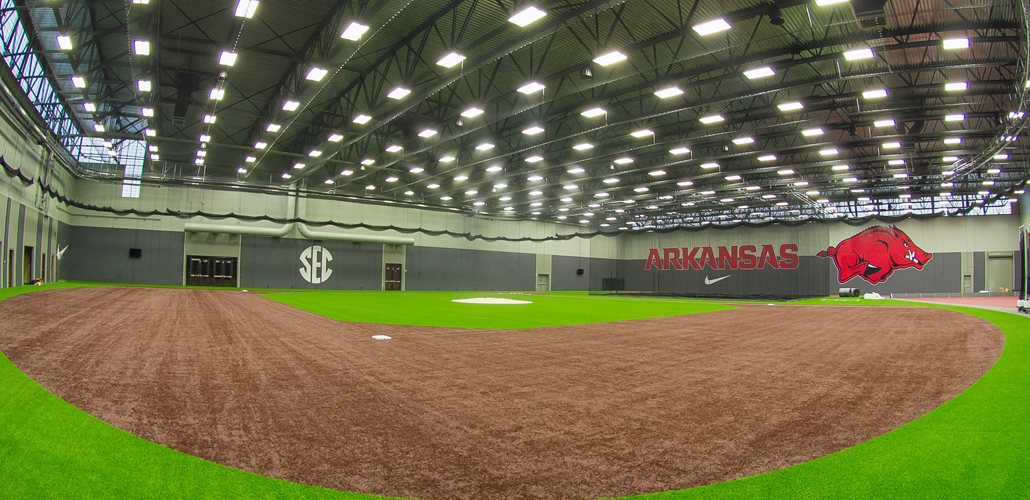
A baseball stadium brings several lighting questions into the same space. How does light cover the playing surface? How consistent is that coverage across different field zones? How do fixture locations and aiming angles relate to the people playing, officiating, and watching the game?
At Baum-Walker Stadium in Fayetteville, Arkansas, Malmstrom White's documented work brought those questions into a computer lighting design before installation. The Baum-Walker Stadium project page presents the completed project, its field lighting photograph, and the scope of work. That scope includes photometric modeling, coordination with the stadium's structure and sightlines, and lighting installation services.
Modeling light across the playing surface
The portfolio describes photometric field lighting design for a Division I collegiate baseball stadium. Malmstrom White modeled foot-candle levels and uniformity across the entire playing surface, with broadcast requirements included in the design brief.
Foot-candle levels describe the amount of light reaching a surface. Uniformity addresses how consistently that light is distributed. Looking at both gives a design team more information than reviewing fixture output alone. At Baum-Walker, the documented modeling covered the full playing surface rather than treating the stadium as a single lighting point.
This is the role of computer lighting design: evaluating a proposed arrangement before the fixtures are installed. For this project, the published scope connects that modeling directly to the field, the stadium structure, and the intended aiming angles.
Reviewing the infield, outfield, and batter's box
The stadium's scope highlights identify three areas where uniformity ratios were confirmed: the outfield, the infield, and the batter's box. Naming those zones makes the design work more specific than a general statement about stadium brightness.
For a facility team reviewing a sports lighting proposal, that is a useful way to organize a discussion. Ask which areas are included in the model and how the proposed lighting distribution is being evaluated in each one. Baum-Walker's project record provides an example of a design that considered individual field zones within the wider playing surface.
Coordinating glare control with sightlines
Light levels were one part of the stadium brief. The project also called for controlling glare for players, umpires, and spectators. Malmstrom White coordinated pole locations and aiming angles with the stadium's structure and sightlines before installation.
Those details connect the lighting layout to the building and the people using it. A field model describes where light is intended to go; coordination of locations and aiming brings the proposed equipment arrangement into that same review. At Baum-Walker, the published scope specifically pairs glare control with player and spectator sightlines.
Carrying the design into installation
The project lists computer lighting design and lighting installation as its delivered services. It also identifies Malmstrom White's Northwest Arkansas office as serving the Fayetteville project.
The documented work offers several practical topics for an athletic facility lighting conversation:
- Define the playing areas that need to appear in the lighting model.
- Review light levels alongside uniformity across those areas.
- Include player, official, and spectator sightlines in the discussion.
- Coordinate pole locations and aiming angles with the facility's structure.
- Connect the design review with installation planning.
Discussing a lighting project in Fayetteville
Explore the full Baum-Walker Stadium project overview to see its photograph and scope highlights. The Fayetteville service-area page provides more information about Malmstrom White's local lighting services.
For teams planning work at an athletic facility, the playing surface and the surrounding sightlines are useful starting points for a lighting brief. Contact Malmstrom White to discuss computer lighting design and installation for your project.